Victorian Beef Gelatin#q=victorian Era Beef Gelatin

Aspic with chicken and eggs
Aspic or meat jelly ()[1] is a savoury gelatin made with a meat stock or goop, prepare in a mold to encase other ingredients. These ofttimes include pieces of meat, seafood, vegetable, or eggs. Aspic is also sometimes referred to every bit aspic gelée or aspic jelly. In its simplest form, aspic is essentially a gelatinous version of conventional soup.
In the United States, similar dishes include jello salads, which are sweet and made using commercial gelatin mixes instead of meat stock or consommé. Elsewhere effectually the world, like non-savoury dishes are oft called gelatin salads. A meat jelly that includes cream is called a chaudfroid.
History [edit]
The 10th-century Kitab al-Tabikh, the earliest known Standard arabic cookbook, contains a recipe for a fish aspic called qaris . This dish was made past boiling several big fish heads with vinegar, parsley, cassia, whole onions, rue, black pepper, ginger, spikenard, galangal, clove, coriander seeds, and long pepper. The resulting dish was then colored with saffron to requite it a "radiant ruddy" color. The cooked fish heads and seasonings were then removed from the cooking liquid earlier the tongues and the lips were returned to steep until the liquid and everything in it had cooled and gelatinized.
According to 1 poetic reference by Ibrahim ibn al-Mahdi, who described a version of the dish prepared with Iraqi carp, it was "like red on the platter, prepare in a pearl ... steeped in saffron thus, like garnet it looks, vibrantly red, shimmering on silver".[2]
Historically, meat aspics were made even before fruit- and vegetable-flavoured aspics. By the Heart Ages, cooks had discovered that a thickened meat goop could exist made into a jelly. A detailed recipe for aspic is institute in Le Viandier, written in or around 1375.[iii]
In the early 19th century, the French chef Marie-Antoine Carême created chaudfroid. The term chaudfroid means "hot cold" in French, referring to foods that were prepared hot and served cold. Aspic was used as a chaudfroid sauce in many cold fish and poultry meals, where it added moisture and season to the nutrient.[4] Carême also invented various types of aspic and ways of preparing information technology.[5]
Aspic came into prominence in America in the early 20th century.[6] By the 1950s, meat aspic was a popular dinner staple,[vii] as were other gelatin-based dishes such as tomato aspic.[6] Cooks showed off their aesthetic skills by creating inventive aspics.[8]
Uses [edit]
Aspic jelly may exist colorless (white aspic) or comprise various shades of amber. Aspic tin be used to protect nutrient from the air, to give food more season, or every bit a decoration.[9] It can also be used to encase meats, preventing them from becoming spoiled. The gelatin keeps out air and bacteria, keeping the cooked meat or other ingredients fresh for longer.[x] In that location are three types of aspic: delicate, sliceable, and inedible.[11] The delicate aspic is soft. The sliceable aspic must be fabricated in a terrine or in an aspic mold. It is firmer than the delicate aspic. The inedible aspic is never for consumption and is usually for decoration. Aspic is ofttimes used to glaze food pieces in nutrient competitions to make the food glisten and brand it more appealing to the heart. Foods dipped in aspic accept a lacquered finish for a fancy presentation.[12] Aspic can exist cutting into various shapes and be used as a garnish for deli meats or pâtés.[thirteen]
Preparation [edit]

The preparation of pork jelly includes placing lean pork meat, trotters, rind, ears, and snout in a pot of cold water and letting it melt over a slow fire for three hours. The broth is immune to cool, while also removing any undesirable fats. Subsequently, white vinegar and the juice of half an orange or lemon can be added to the meat then that it is covered. The unabridged mixture is and so allowed to cool and gel. Bay leaves or chili tin can be added to the broth for added taste (the Romanian variety is based on garlic and includes no vinegar, orangish, lemon, chili, bay leaves, etc.). However, there are many alternate ways of preparing pork jelly, such equally the usage of celery, beef and even sus scrofa bones. Poultry jellies are fabricated the same mode as making pork jelly, merely less water is added to recoup for lower natural gelatin content.
Almost any type of food can exist set into aspics, and almost any type of meat (poultry or fish included) can be used to make gelatin, although in some cases, additional gelatin may exist needed for the aspic to set properly. Stock can be clarified with egg whites and then filled and flavored only before the aspic sets. The most mutual are pieces of meat, seafood, eggs, fruits, or vegetables. Veal stock (in detail, stock from a boiled calf's pes) provides a swell bargain of gelatin, and so other types of meat are often included when making stock.
Fish consommés normally have too little natural gelatin, so fish stock may exist double-cooked or supplemented. Since fish gelatin melts at a lower temperature than the gelatins of other meats, fish aspic is more fragile and melts more readily in the oral fissure. Virtually fish stocks ordinarily do not maintain a molded shape with their natural gelatin alone, so additional gelatin is added.[12]
Vegetables have no natural gelatin.[14] However, pectin serves a like purpose in culinary applications such every bit jams and jellies.
Global variations of aspic [edit]
Pork jelly [edit]
Pork jelly is an aspic made from low-grade cuts of grunter meat, such as trotters, that incorporate a significant proportion of connective tissue.[15] Pork jelly is a pop appetizer and, nowadays, is sometimes prepared in a more than modern version using lean meat, with or without squealer leftovers (which are substituted with shop-bought gelatin). It is very popular in Croatia, Serbia, Poland, Czech Republic, Romania, Moldova, Republic of estonia, Latvia, Lithuania, Slovakia (called huspenina/studeno ), Hungary, Greece, and Ukraine. In Russia, Belarus, and Ukraine, information technology is known as kholodets , kholodne during Christmas or Easter. In Russia, kholodets is a traditional winter and particularly Christmas and New Twelvemonth'due south dish, which is eaten with chrain (horseradish paste) or mustard.[16] It is likewise eaten in Vietnam ( thịt nấu đông ) during Lunar New year's day. The meat in pork pies is preserved using pork jelly.

Pihtije [edit]

Pihtije on lettuce with eggs

Pihtije (Serbian: пихтије), pivtija (Macedonian: пивтија), pača (Bulgarian: пача) is an aspic-similar dish, generally fabricated from lamb, chicken or pork meat, such as the head, shank, or hock, fabricated into a semi-consistent gelatinous cake-like class. In some varieties, chicken is used instead of pork. Some recipes as well include smoked meat and are well spiced.
Pihtije is commonly simply ane component of the traditional repast (or an titbit), although it can exist served as a main dish. It is usually accompanied by cold mastika or rakija (grape brandy) and turšija (pickled tomatoes, peppers, olives, cauliflower, cucumber).
The recipe calls for the meat to be cleaned, done, and and so boiled for a short time, no longer than 10 minutes. So the water is changed, and vegetables and spices are added. This is cooked until the meat begins to divide from the bones, and then the bones are removed, the meat stock is filtered, and the meat and stock are poured into shallow bowls.
Garlic is added as well equally thin slices of tomatoes or green peppers (or something similar for decoration). It is left to sit in a common cold spot, such as a fridge or outside if the weather is cold enough. It congeals into jelly and can be cut into cubes (it is often said that proficient pihtijas are "cut like drinking glass"). These cubes can exist sprinkled with various spices or herbs as desired before serving.
Pihtije is usually cut and served in equal sized cubes.
Pihtije are frequently used in slavas and other celebratory occasions with Serbs.
Romanian and Moldovan piftie [edit]

Moldovan chicken răcitură
Romanian and Moldovan piftie is also chosen răcitură (plural răcituri ), derived from the Romanian rece , meaning common cold. Piftie has a unlike method of preparation. It is usually made with pig'southward trotter (but turkey or chicken meat can as well be used), carrots and other vegetables, boiled to make a soup with high gelatin content. The broth containing gelatin is poured over the boiled meat and mashed garlic in bowls, the mixture being then cooled to become a jelly. Piftie is traditionally served for Epiphany.
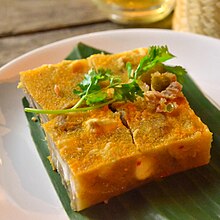
Korea [edit]
Jokpyeon ( 족편 ) is a dish prepared by boiling beef and pork cuts with high collagen content such as the caput, pare, tail, cow's trotters, or other cuts in water for a long time. The resulting stewing liquid sets to course a jelly-like substance when cooled.[17] [18]
Nepal [edit]
Amongst the Newars of Kathmandu Valley in Nepal, buffalo meat jelly, known every bit ta khaa , is a major component of the winter festivity gourmet. It is eaten in combination with fish aspic ( sanyaa khunna ), which is made from dried fish and buffalo meat stock, soured, and containing a heavy mix of spices and condiments.[ citation needed ]
Poland [edit]
In Central, Eastern, and Northern Europe, aspic frequently takes the form of pork jelly and is popular effectually the Christmas and Easter holidays. In Poland, certain meats, fish and vegetables are set up in aspic, creating a dish called galareta .
Eastern Europe [edit]
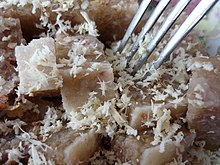
Kholodets with chopped horseradish
In Belarusian, Russian, and Ukrainian cuisine, a meat aspic dish is called kholodets (Belarusian: халадзец [xalaˈd͡zʲɛt͡s]; Russian: холодец [xəlɐˈdʲets]; Ukrainian: холодець [xoloˈdɛtsʲ] (  mind ); besides written as holodetz exterior these countries) derived from the discussion kholod meaning "cold". In some areas it is chosen studen' ( студень ) or studenets ( студенец ), derived from a different root with a like meaning.
The dish is part of wintertime holiday celebrations such equally the traditional Russian New year's day (novy god) or Christmas repast. Yet, modern refrigeration allows for its year-round production, and it is not uncommon to encounter kholodets on a Russian table in summer.
Kholodets is usually made by boiling the bones and meat rich in collagen for nigh 5–8 hours[19] to produce a thick and fatty goop, with the collagen hydrolizing into the natural gelatin, mixed with salt, pepper, and other spices. The meat is and so separated from the bones, minced, recombined with the broth and cooled until information technology solidifies into a jelly. Kholodets is usually eaten with chrain or mustard.
Croatia [edit]
The Croation version of this dish is called hladetina ( hladno meaning cold). Variants range from i served in a dish with rather delicate gelatin, to tlačenica more resembling the German sulze, a kind of head cheese.
Slovenia [edit]
In Slovenia, aspic is known every bit žolca (derived from the German sülze , meaning head cheese) or tlačenka in Slovene. It is traditionally served at Easter.
Denmark [edit]
In Kingdom of denmark, aspic is called sky and is made from meat juices, gelatin, and sometimes mushrooms. Sky is almost solely eaten every bit a topping for common cold cuts or rullepølse on Danish open faced sandwiches called smørrebrød . It is a key ingredient in Dyrlægens natmad , a dish combining leverpostej , sliced common salt beef and onions. Sky, with or without mushrooms, is an easy-to-find production in most supermarkets.
Georgia [edit]
Mujuji or muzhuzhi (Georgian: მუჟუჟი ) is a traditional Georgian dish of common cold jellied pork. Its ingredients include pork meat, tails, ears, feet, carrots, vinegar, garlic, herbs, onions, roots, bay leaves, allspice, and cinnamon.[xx] [21] [22] In some recipes, the dish is cooked in two split up processes, slightly pickled with wine vinegar and spiced with tarragon and basil. One part contains pork feet, tails and ears; the other contains the lean meat of piglets. They are combined into ane dish, chilled and served with green onions and spicy herbs.[23]
Belgium [edit]
Rog in 't zuur or rog in zure gelei is a Flemish traditional recipe to preserve ray wings which are otherwise notoriously quick to spoil. Ray wings are poached in a fish stock with vinegar, spices and onions, then preserved by adding gelatin to the stock and roofing the fish with the gelatin stock. In this manner the fish would go along 2-4 days without refrigeration. The dish is served cold with bread for breakfast or as a snack, or can be served as an appetizer. [24]
Health benefits [edit]
Aspic is a source of:
- iron
- vitamin A
- vitamin K
- fatty acids
- selenium
- zinc
- magnesium
- phosphorus
An amino acid called glutamine in aspic may help with leaky gut, inflammatory bowel disease and other digestive problems (Source: Glutamine and the regulation of abdominal permeability: from bench to bedside).
Glycine from aspic can improve sleep and reduce fatigue during the day (Source: The Sleep-Promoting and Hypothermic Effects of Glycine are Mediated by NMDA Receptors in the Suprachiasmatic Nucleus [1]).
See besides [edit]
- Chaudfroid sauce
- Cretons
- Garde manger
- Galantine
- Caput cheese
- Jell-O
- Larks' Tongues in Aspic
- Khash
- Meat-jelly Festival
- Pâté
- P'tcha
- Sus scrofa's trotters
- Terrine
References [edit]
Notes
- ^ "aspic substantive - Definition, pictures, pronunciation and usage notes | Oxford Advanced Learner's Dictionary at OxfordLearnersDictionaries.com". www.oxfordlearnersdictionaries.com . Retrieved 2020-10-12 .
- ^ Nasrallah, Nawal (2007). Annals of the Caliphs' Kitchens. Brill.
- ^ Scully, Terence (January 1, 1988). The viandier of Taillevent: an edition of all extant manuscripts. Ottawa, Ontario: University of Ottawa Press. p. 270. ISBN978-0-7766-0174-8.
- ^ "Chaud Froid: Clarifying an Opaque Subject area". Garde Manger. Archived from the original on December 3, 2010. Retrieved October 10, 2010.
- ^ "Aspic: An Development of Utilise and Abuse". Garde Manger. Archived from the original on 13 November 2010. Retrieved October 10, 2010.
- ^ a b Smith, Andrew (March 2007). The Oxford Companion to American Food and Drink. New York, New York: Oxford Academy Press. pp. 514, 292. ISBN978-0-xix-530796-2.
- ^ "The Way We Eat: Salad Daze". The New York Times. July ix, 2006. Retrieved October 10, 2010.
- ^ Allen, Gary; Ken Albala (October 30, 2007). The Business concern of Food: Encyclopedia of the Nutrient and Drink Industries . Westport, Connecticut: Greenwood Publishing Group. pp. 177. doi:ten.1336/031333725X. ISBN978-0-313-33725-3.
- ^ Gisslen, Wayne (March 2006). Professional person Cooking, 6th edition. Hoboken, New Jersey: John Wiley and Sons. p. 849. ISBN978-0-471-66376-eight.
- ^ "Aspic Aspirations". The Guardian (U.K.). Apr 30, 2010. Retrieved October 10, 2010.
- ^ "Aspic:Textures and Facts". Garde Manger. Archived from the original on 13 November 2010. Retrieved October 10, 2010.
- ^ a b Ruhlman, Michael; Anthony Bourdain (November 2007). The Elements of Cooking: Translating the Chef's Craft for Every Kitchen . New York, New York: Simon and Schuster. ISBN978-0-7432-9978-seven.
- ^ Nenes, Michael (March 2006). American Regional Cuisine, 2nd edition. Hoboken, New Bailiwick of jersey: Fine art Constitute. p. 547. ISBN978-0-471-68294-3.
- ^ "What'due south gelatin made of? | Library Answer Person". Retrieved 2020-ten-28 .
- ^ "food preservation - Why do they put the jelly-like substance in pork pies? - Seasoned Advice". Cooking.stackexchange.com. Retrieved 2016-01-05 .
- ^ "The Weird Wobbly Meat Jello That Is Russian Kholodets | That's What She Had". thatswhatshehad.com. 17 July 2018. Retrieved 2018-09-24 .
- ^ "jokpyeon" 족편. Standard Korean Language Lexicon (in Korean). National Institute of Korean Linguistic communication. Retrieved 29 Apr 2017. [ permanent dead link ]
- ^ "Kinds of Korean Nutrient". Korea Agro-Fisheries Trade Corporation. Archived from the original on 14 April 2009. Retrieved 17 May 2008.
- ^ Different the Japanese tonkotsu broth, which is cooked at a vigorous rolling boil, producing thick milky-white stock in which fats and collagen are well emulsified, kholodets goop is barely simmered, so the resulting stock is clear and maybe farther cleared with egg whites or by filtering.
- ^ The Georgian Feast: The Vibrant Culture and Savory Food of the Commonwealth of Georgia, Darra Goldstein, p. 96
- ^ Running With Echoes of Want, Lourdes Odette Aquitania Ricasa, p. 486
- ^ Грузинская кухня. Рыбные блюда. Мясные блюда, p. 9515
- ^ "МУЖУЖИ в кулинарном словаре". langet.ru . Retrieved 2020-10-12 .
- ^ "Rog in het zuur".
Bibliography
- Allen, Gary; Ken Albala.The Concern of Food: Encyclopedia of the Nutrient and Drink Industries.Westport, Connecticut: Greenwood Publishing Group, October 2007. ISBN 0-313-33725-10.
- Gisslen, Wayne.Professional Cooking, 6th edition. Hoboken, New Bailiwick of jersey: John Wiley and Sons, March 2006. ISBN 978-0-471-66376-8
- Nenes, Michael. American Regional Cuisine, 2nd edition. Hoboken, New Bailiwick of jersey: Art Constitute, March 2006. ISBN 978-0-471-68294-3.
- Ruhlman, Michael; Anthony Bourdain. The Elements of Cooking: Translating the Chef's Craft for Every Kitchen. New York, New York: Simon and Schuster, Nov 2007. ISBN 0-7432-9978-7.
- Smith, Andrew. The Oxford Companion to American Food and Drink. New York, New York: Oxford Academy Press, March 2007. ISBN 0-xix-530796-8.
External links [edit]
- Encyclopedia of Food and Culture: Gelatin
- Latvian pork aspic
- Russian Meat Aspic
Source: https://en.wikipedia.org/wiki/Aspic

Post a Comment for "Victorian Beef Gelatin#q=victorian Era Beef Gelatin"