what quantum number of the hydrogen atom comes closest to giving a 95-nm-diameter electron orbit?
Free energy OF ELECTRON IN northwardthursday BOHR'S ORBIT - FORMULA-SOLVED QUESTION
IIT JEE - NEET
Spotter the following video to go an idea about Free energy of electron in Bohr'southward orbit.
Question - The energy of an electron in the first Bohr orbit of H atom is -13.6 eV. The possible free energy value(due south) of the excited state(southward) for electrons in Bohr orbits of hydrogen is (are) :
(IIT JEE 1998)
a) -3.4 eV
b) -iv.ii eV
c) -half-dozen.8 eV
d) +6.8 eV
Answer: a
Logic:
The energy of an electron in Bohr'south orbit of hydrogen atom is given by the expression:
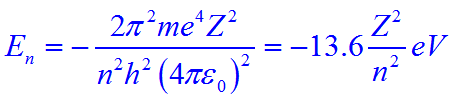
Since Z = 1 for hydrogen in a higher place equation can be further simplified to:
En = -13.6/ntwo eV
Solution:
The energies of electrons in the Bohr'south orbits of hydrogen atom expressed in eV are:
| Orbit | Energy |
| 1 | -13.six/12 = -xiii.half-dozen eV |
| 2 | -13.6/22 = -iii.four eV |
| 3 | -13.6/three2 = -1.51 eV |
| four | -13.six/42 = -0.85 eV |
Excited state(due south) represent n = 2, iii, 4 ...... (greater than 1).
Notation:
The ratio of energy of electrons in the orbits of hydrogen atom is:
Eastward1 : E2 : Due east3 : E4 ........... = one/1ii : i/iitwo : 1/three2 : 1/42 .......... = one : 1/4 : 1/ix : 1/sixteen ..........
Determination:
Correct option is "a".
Energy of electron in the nth Bohr's orbit - Followup questions & answers
Question-1) With increase in master quantum number, n, the free energy departure between next free energy levels in Hydrogen atom:
(Eamcet - 2009-One thousand)
a) Increases
b) Decreases
c) Remains abiding
d) Decreases for lower values of n and increases for higher values of n
Answer: b
Solution:
From the previous trouble, we can clearly come across the decrease in energy difference betwixt adjacent levels with increase in the principal quantum number, n. (see the tabular array or ratio)
Question-2) If the electron of a hydrogen atom is present in the starting time orbit, the total free energy of the electron is:
(Eamcet - 2003-Due east)
a) -due east2/r
b) -e2/rii
c) -etwo/2r
d) -due east2/2rtwo
Answer: c
Solution:
Full Energy of electron, Due easttotal = Potential energy (PE) + Kinetic energy (KE)
For an electron revolving in a circular orbit of radius, r around a nucleus with Z positive accuse,
PE = -Zetwo/r
KE = Ze2/2r
Hence:
Eastwardfull = (-Zeii/r) + (Zeii/2r) = -Ze2/2r
And for H cantlet, Z = ane
Therefore:
Etotal = -eii/2r
Note:
This is non a expert question because 'r' value is a variable and depends on the principal quantum number, n. Really it is the energy of electron in the northth orbit and not only for 1st orbit.
Then why this question is added?
To show that the questions given in entrance exams are always not perfect. So think outside the box also.
What to do when questions like this are asked?
Be flexible in your thinking. Though questions similar this are not perfect, choose the right answers wisely among the options given.
Question-3) The ionization enthalpy of hydrogen atom is 1.312 x 10-vi J mol-1. The energy required to excite the electron in the cantlet from northward=one to n=two is:
(AIEEE-2008)
a) 8.51 ten tenfive J mol-ane
b) 6.56 x ten5 J mol-1
c) seven.56 x 105 J mol-ane
d) 9.84 x x5 J mol-ane
Reply: d
Logic:
We know that free energy of nth orbit,
Eastwardn = -K/n2 (for hydrogen atom), where Thou is a constant.
The energy required to excite the electron from due north = 1 to n = ii is:
ΔE(two,1) = Eii- E1
= (-M/due north2 two) - (-K/due north1 2)
= Grand(1/n1 2 - i/due northii 2)
= G(1/12 - one/2two)
So we have to know the value of 'K'. This can be done past using ionization enthalpy data.
Ionization enthalpy is the free energy required to take the electron from northward = 1 orbit to northward = ∞ orbit. Hence ionization energy must exist equal to the energy difference between these two orbits.
i.e.
Ionization energy = ΔE(∞,ane) = Due east∞- East1
ΔE(∞,1) = (-Chiliad/n∞ ii) - (-K/n1 2) = (-K/∞ii) - (-K/oneii) = M/north1 2 = K
Therefore:
K = one.312 x 10-6 J mol-1
Solution:
Now we tin summate the free energy required to excite the electron from n = ane to n = 2 equally follows.
ΔE(2,1) = One thousand(1/i2 - one/iitwo)
= 1.312 x 10⁻⁶ J mol-1 (1/12 - i/two2)
= ix.84 x ten5 J mol-one
Note:
Ionization energy = ΔE(∞,1) = Eastward∞- E1 = - E1
Hence we tin take negative of ionization free energy as the energy of the ground land (n=1).
Question-4) Ionization energy of He+ is xix.6 x 10-18 J cantlet-1. The energy of the starting time stationary state ( north = i) of Liii+ is:
(AIEEE-2003)
ane) 4.41 ten x-16 J atom-one
ii) -4.41 10 ten-17 J atom-1
iii) -ii.2 x ten-fifteen J atom-one
iv) 88.2 10 10-17 J atom-ane
Reply: 2
Logic:
Since negative of Ionization free energy is the energy of first stationery state, for He+, the energy of 1st level is -19.six x 10-18 J atom-1.
The energy of electron in 1st level for He+ can exist written as:
Eone = -K(Z2/n2) = -M x (22/12) = -4K
Hence
Yard = -xix.6 x 10-18 / iv = iv.ix x 10-eighteen J cantlet-ane
Solution:
The energy of commencement energy level of Li2+ = -K(Ztwo/due north2) = -K 10 (32/one2) = -9K = -9 x 4.9 10 ten-18 = -4.41 x x-17 J atom-one
Question-5) Free energy of an electron is given by E = -2.178 x 10⁻¹⁸ (Zii/n2) J. Wavelength of light required to excite an electron in an hydrogen atom from level n=i to north=ii will be:
(IIT-JEE Primary 2013)
1) i.216 x 10-7m
b) two.816 x 10-7grand
c) 6.500 x ten-7thou
d) 8.500 x 10⁻⁷m
Answer: 1
Logic:
Energy required to excite electron from northward=one to n=2 volition be equal to the energy departure between these levels.
i.due east.
ΔE(ii,ane) = Eastward2- Eane
= (-K/ntwo ii) - (-K/n1 two) (for H atom, Z = 1)
= K(1/northward1 2 - 1/n2 two)
= 1000(ane/1two - 1/22)
= 3K/4
= (three/4) x 2.178 x 10-xviii J
= 1.6335 x ten-eighteen J
Solution:
The wavelength respective to higher up excitation:
λ = hc/Eastward = (half-dozen.626 x 10-34 J south ten 3.0 x 10eight m southward-one) / (ane.6335 x 10-18 J )
= ane.216 x 10-seven1000
Question-6) Based on equation East = -2.178 x 10⁻¹⁸ (Z2/n2) J , certain conclusions are written. Which of them are non correct?
(IIT JEE Avant-garde - 2013 )
a) Larger the value of north, the larger is the radius of orbit.
b) Equation can exist used to calculate the modify in free energy when the electron changes orbit.
c) For n=i, the electron has a more negative energy than it does n=6 which means that the electron is more loosely spring in the smallest allowed orbit.
d) The negative sign in equation simply means that the energy for electron bound to the nucleus is lower than it would be if the electrons were at the space distance from the nucleus.
Reply:
option "c" is the wrong argument.
Explanation:
The energy of electron in a particular orbit is equal to the loss in energy of electron when it is taken from infinite orbit to that orbit. Energy of electron in the infinite orbit is zero which too indicates at that place is no attraction between nucleus and electron. Just when it is bring closer towards the nucleus, there is loss of energy due to attraction and hence the energy in the orbitals for which n < ∞ is always negative. Greater the negative value greater is the attraction.
Hence the last half office of statement given in the option "c" is wrong.
Question-7) The orbital degeneracy of the level of a 1 electron diminutive system with Z = five and free energy -thirteen.six eV, is:
(From CSIR Internet December 2022 - Solved practice question - quantum mechanics - AdiChemistry - V. Aditya vardhan - Complimentary report material pdf-html-sample-GATE Chemical science - IIT JAM - SET exams - online coaching)
1) 1
2) 25
3) v
4) 36
Answer: 2
Solution:
Kickoff of all we have to find the due north value for the energy level.
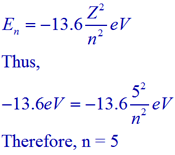
For one electron diminutive organization (hydrogen like atom), the orbitals in a given orbit are degenerate irrespective of their azimuthal quantum number (l). The energy is decided by chief quantum number (n) only. Hence the number of degenerate orbitals is equal to the number of orbitals in a principal quantum level and is given by n2.
Therefore, the degeneracy for the 5th level in hydrogen like atom (or ion) = 52 = 25.
(new) Click here to meet 3d Interactive Solved Question paper
Practice questions & answers - free energy of an electron in the nth bohr orbit of hydrogen atom
one) Write the values of energy of ground state in hydrogen atom in different units.
2) What is the ratio of energies of electrons in the basis states of H, He+, Li2+and Be3+?
iii) Calculate the atomic number of hydrogen like species which can be ionized past an electron moving with a velocity, five = 6.56 × 10six m s-1 .
Hint: The electron must be in the first orbit, since it is hydrogen like species i.e. n = 1. Now we have to observe the atomic number, Z from the equation
v = 2.18 x 10vi 10 Z k south-i
Z = v / 2.18 x 10half dozen 10 Z m south-1 = vi.56 × ten6 m south-i / 2.18 x 10⁶ 10 Z m s-i= iii
The species is Be2+.
Click here for more solved problems on velocity of electrons.
4) Write the formula/expression for energy of electron in the nth orbit of hydrogen atom.
5) What is the kinetic energy of northth orbit of hydrogen atom.
6) How do y'all calculate the total energy of electron in the due northth stationary orbit of hydrogen cantlet?
7) The energy of an electron in the nth Bohr'southward orbit is proportional to ____________ .
Question- 8) What is the energy of electron in 3rd Bohr's orbit of hydrogen atom?
Answer: -i.51 eV
Question-9) Kinetic energy (KE) of electron in a particular orbit is 3.4 eV. The potential energy is ___________ .
Answer: -six.8 eV
10) If energy of electron in a hydrogen cantlet is -RH /9. The possible number of orbitals in this hydrogen cantlet is _______ . Where RH is Rydberg constant.
Question-xi) What is the departure in the energies of 1st and 2d Bohr's orbits of H-atom?
Answer: -3.4 - (-xiii.6) = 10.2 eV
Question-12) What is the total energy of an electron in the n=4 Bohr orbit of the hydrogen atom ?
Answer: -0.85 eV.
13) Summate the energy required to excite an electron of Hydrogen atom from first orbit to 2d orbit.
Question-14) Why is the free energy of electron negative in the hydrogen atom?
Answer: The free energy of costless electron (when there is no attraction with nucleus) is arbitrarily fixed as zero and the free energy decreases when information technology is attracted towards nucleus.
fifteen) What is the potential free energy of an electron nowadays in due north shell of Be3+ ion?
Question-xvi) What is the free energy possessed past an electron for northward=infinity?
Reply: Arbitrarily fixed as zippo. Non that information technology should be free from any other external forces of attraction or repulsion as well every bit it should possess zero velocity.
17) Write the ratio of energy of the electron in ground state of hydrogen.
Question-eighteen) Calculate the potential energy of an electron in the first Bohr orbit of Li2+ ion?
Reply: 122.4 eV
xix) The free energy of an electron in the nth Bohr orbit of hydrogen cantlet is given by ......
20) What is the kinetic energy of electron revolving in second excited land?
Question-21) What minimum amount of energy (in J) is required to bring an electron from footing land of Exist3+ ion to infinity?
Respond: 217.half-dozen eV
Question-22) If the energy of electron in ist orbit of hydrogen is –thirteen.6 ev/atom then the energy of electron in 4th orbit of He+ ion is (in ev/atom)..........
Answer: -13.six eV
23) The energy required to remove an electron in a hydrogen atom from n=10 country is ...........
Question-24) If the energy of third orbit of He+ ion is –x kJ mol–one, then the free energy of 2d orbit of H-cantlet (in kJ mol–1) volition be......
Respond: -9x/16 kJ mol-i
Hint: Due east(H in 2nd orbit) : Due east(He in tertiary orbit) = (Z/n)2 H : (Z/n)2 He = (1/two)ii : (2/iii)ii = nine:16
25) The ratio of the energy of electrons in 1st shell of He+ and 3rd trounce of Li+2 is.............
26) Potential free energy of electron in 2nd orbit of Li2+ is ..........
27) If the ionization potential of hydrogen atom is 13.6ev, then the energy required to remove the electron from the third orbit of hydrogen cantlet is nearly in ev is ..........
Question-28) Relation betwixt potential energy, kinetic energy and total energy of an electron in a particular orbit is given past.........
Respond: PE = -2KE = 2TE
29) Calculate the energy required to transport an electron of Li+two ion from ground land to 2nd excited country in J/mol.
30) The free energy of second orbit of hydrogen is equal to the free energy of ..............
Question-31) The ratio of the kinetic energy and the potential energy of electron in the hydrogen atom will exist ..........
Respond: 1:(-two)
Jump to Spectral lines & electronic transitions in hydrogen atom - IIT JEE - NEET - Information technology JAM solved problems
Source: http://www.adichemistry.com/jee/qb/atomic-structure/1/q6.html

Post a Comment for "what quantum number of the hydrogen atom comes closest to giving a 95-nm-diameter electron orbit?"