Art Project Every Color in a Novel Horizontal Lines
This page provides definitions and examples of the elements of art that are used past artists working in various media. The elements of fine art are components or parts of a work of fine art that can be isolated and defined. They are the building blocks used to create a work of art.
Students who tin identify the elements and evaluate their role in the composition of a work of art will be better able to understand an artist'south choices. They volition be equipped to address whether a work of art is successful, and why.
The arrangement of elements in a work of art. All works of art have an order determined by the artist. Composition creates a hierarchy inside the work, which tells the viewer the relative importance of the imagery and elements included.
Symmetrical compositions convey a sense of stability. In this example, a single large figure in the center is flanked by a smaller effigy on either side. The shape of the artwork itself is also symmetrical—a vertical line bisecting the paradigm would create two equal halves that are mirror images of one some other.

Asymmetrical compositions often convey a sense of move since the elements of the limerick are unbalanced. In this example, the artist used organic forms to create a composition that mimics the move of vines growing in an unordered fashion around the clock face.
Line
A line is an identifiable path created by a point moving in space. It is i-dimensional and tin vary in width, management, and length. Lines often ascertain the edges of a grade. Lines can be horizontal, vertical, or diagonal, straight or curved, thick or thin. They lead your eye around the limerick and can communicate information through their grapheme and management.
Examples:
Horizontal lines suggest a feeling of rest or repose because objects parallel to the world are at residual. In this landscape, horizontal lines also help give a sense of space. The lines delineate sections of the landscape, which recede into space. They also imply continuation of the mural beyond the picture aeroplane to the left and correct.
Vertical lines oft communicate a sense of pinnacle because they are perpendicular to the globe, extending upwards toward the sky. In this church interior, vertical lines propose spirituality, ascent beyond human reach toward the heavens.
Horizontal and vertical lines used in combination communicate stability and solidity. Rectilinear forms with xc-degree angles are structurally stable. This stability suggests permanence and reliability.
Diagonal lines convey a feeling of move. Objects in a diagonal position are unstable. Considering they are neither vertical nor horizontal, they are either almost to fall or are already in move. The angles of the transport and the rocks on the shore convey a feeling of motion or speed in this stormy harbor scene.
In a ii-dimensional composition, diagonal lines can also indicate depth through perspective. These diagonal lines pull the viewer visually into the image. For case, in this photograph the diagonal lines lead the eye into the space to the betoken where the lines converge.
The curve of a line tin convey energy. Soft, shallow curves remember the curves of the homo body and often have a pleasing, sensual quality and a softening effect on the limerick. The edge of the puddle in this photograph gently leads the center to the sculptures on the horizon.
Sharply curved or twisted lines can convey turmoil, chaos, and even violence. In this sculpture, the lines of the contorting bodies and the serpent help convey the intensity of the struggle against the snake'south stranglehold.
When repeated, lines can create a pattern. In this example, the artist repeated dissimilar kinds of lines across the limerick to create diverse patterns. Patterned lines likewise requite the image rhythm.
Shape and form
Shape and form define objects in infinite. Shapes have 2 dimensions—height and width—and are normally defined past lines. Forms exist in three dimensions, with meridian, width, and depth.
Examples:
Shape has simply height and width. Shape is commonly, though not ever, defined past line, which tin can provide its contour. In this epitome, rectangles and ovals dominate the composition. They draw the architectural details for an illusionist ceiling fresco.
Form has depth likewise as width and height. 3-dimensional form is the basis of sculpture, furniture, and decorative arts. 3-dimensional forms can be seen from more one side, such as this sculpture of a rearing equus caballus.
| | 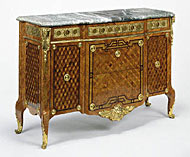 |
Geometric shapes and forms include mathematical, named shapes such every bit squares, rectangles, circles, cubes, spheres, and cones. Geometric shapes and forms are often homo-fabricated. Still, many natural forms as well have geometric shapes. This cabinet is decorated with designs of geometric shapes.
Organic shapes and forms are typically irregular or asymmetrical. Organic shapes are ofttimes found in nature, but man-made shapes can also imitate organic forms. This wreath uses organic forms to simulate leaves and berries.
Repeated shapes and forms also create patterns. On this manuscript page, the repeating organic floral shapes create a blueprint.
In this photograph, geometric shapes and lines are repeated to create a pattern.
Space
Existent space is three-dimensional. Space in a work of art refers to a feeling of depth or three dimensions. It can also refer to the artist's use of the area within the picture plane. The surface area around the primary objects in a work of art is known every bit negative space, while the space occupied by the main objects is known equally positive space.
Examples:
Positive and negative space
The human relationship of positive to negative infinite can greatly bear upon the impact of a work of art. In this drawing, the man and his shadow occupy the positive space, while the white infinite surrounding him is the negative space. The asymmetric amount of negative space accentuates the effigy's vulnerability and isolation.
Iii-dimensional space
The perfect illusion of three-dimensional space in a two-dimensional work of art is something that many artists, such as Pieter Saenredam, labored to achieve. The illusion of space is achieved through perspective cartoon techniques and shading.
Colour
Light reflected off objects. Color has three main characteristics: hue (red, green, blue, etc.), value (how lite or dark information technology is), and intensity (how bright or tiresome information technology is). Colors can be described as warm (red, yellow) or cool (blue, gray), depending on which end of the color spectrum they fall.
Examples:
Value describes the brightness of colour. Artists employ colour value to create different moods. Dark colors in a limerick suggest a lack of light, as in a night or interior scene. Dark colors can often convey a sense of mystery or foreboding.
Lite colors often depict a light source or light reflected inside the composition. In this painting, the nighttime colors suggest a nighttime or interior scene. The artist used light colors to describe the light created by the candle flame.
Intensity describes the purity or strength of a color. Brilliant colors are undiluted and are often associated with positive energy and heightened emotions. Dull colors have been diluted by mixing with other colors and create a sedate or serious mood. In this epitome the creative person captured both the seriousness and the joy of the scene with the dull gray rock interior and the bright cherry drapery.
Texture
The surface quality of an object that we sense through impact. All objects have a physical texture. Artists can as well convey texture visually in two dimensions.
In a two-dimensional work of art, texture gives a visual sense of how an object depicted would experience in real life if touched: hard, soft, rough, smooth, hairy, leathery, precipitous, etc. In three-dimensional works, artists use actual texture to add a tactile quality to the piece of work.
Examples:
Texture depicted in two-dimensions
Artists use color, line, and shading to imply textures. In this painting, the human being's robe is painted to simulate silk. The ability to convincingly portray fabric of different types was one of the marks of a great painter during the 17th century.
 | |
Surface texture
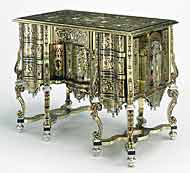
The surface of this writing desk is metallic and hard. The hard surface is functional for an object that would have been used for writing. The smoothen surface of the writing desk reflects light, adding sparkle to this piece of article of furniture.
Source: https://www.getty.edu/education/for_teachers/building_lessons/elements.html

Post a Comment for "Art Project Every Color in a Novel Horizontal Lines"